No Collections Here
Sort your projects into collections. Click on "Manage Collections" to get started
Creating Easter Marketing Campaign With a Game
UX Case for a well-known fast food chain
Sector
Private, quick service, multinational fast food chain
Technology
Native application for Android and iOS
Market
German
Challenge
How to create engagement and connect with users' Inner Child
Role
UX and UI Designer, Researcher
In project
Since 2021 - now
Campaign description
The Easter Campaign is available to users every year from March to April (4 weeks). The core part of the campaign is the “Coupon of the Day”, where users can redeem every day a new coupon that is available in the app.
The campaign has been presented to users for several years now, and most people were already familiar with it. That's why this time we decided to create a more engaging and groundbreaking experience for users.
Objectives from briefing
Business goal:
Increase loyalty registration, awareness for the application and digital sales
Marketing goal:
Create engagement with the entire application and loyalty program, establishment of Easter Campaign platform and expanding it, “Brand for someone like me/ share the pen” - relevant for Gen Z, Increase positive brand engagement with a surprising and fun campaign
Cultural relevance:
Not only our guests, the whole country can relate
KPI
App downloads and overall engagement score
Target groups
The target group for our campaign was Gen Z, Teens and Twenties. These are people with lower incomes, and with the current tense financial situation, most of our users were looking for “good deals”. That's why affordability became the key word.
The aspect of fun is also important for this group, and one of our goals was to build engagement, which is why creating FOMO (Fear of Missing Out) among users became another pillar of the campaign.
Research
Data from clients research team

Survey
It was very important to anchor the campaign in culture. That is why we conducted quantitative research in the form of a survey, which allowed us to identify key values and positive associations with the Easter period for people living in Germany.
80% of all responders mentioned ‘egg hunting’ as something memorable and Easter relevant.
The best thing about Easter is:
“Searching for Easter eggs with the family in a competitive environment”
“Spending time with my family, feeling like a child again while searching for eggs”
Main associations:
1. Family time
2. Egg hunting
3. Searching fun
4. Competition
Desk research
The data from client and our survey directed our research toward the gamification and gaming market, which could satisfy the need for fun and competition.
Value and growth of gamification market worldwide in 2016 and 2021

Positive aspects of gamification:
-
extends brand loyalty
-
transforms customer processes into more enjoyable, fun and engaging ones
-
higher retention rates of customers/users
-
motivational for users, reaches and caters to “inner child”
-
increases awareness of loyalty program
Idea based on research and briefing
Final proposal - game involving searching for eggs
After conducting research, we decided to use the culture of searching for eggs in the form of a game, so as to preserve the element of surprise and fun (based on the criteria from the briefing).
Our advantage: Users are already familiar with looking for eggs in our app, because we used this pattern
in previous years, e.g. searching for eggs in your surroundings using Augmented Reality.

After finding one egg, another would appear somewhere else – some eggs were harder to find than others. The user had 20 seconds to find as many eggs as possible.
The final score was calculated based on users speed and type of egg found (eggs that were harder to find had a higher value).

Business goal:
Awareness for the application
Marketing goal:
Establishment of Easter Campaign platform and expanding it, “Brand for someone like me/share the pen”
Cultural relevance:
Not only our guests, the whole country can relate
How to make this game even more engaging?
During the process, we felt that one factor was still missing – FOMO. Ultimately, while researching various gamification mechanics, our attention was drawn to the leaderboard aspect, and that's what we chose to use.

The leaderboard resonated well with the competitive aspect of egg hunt and fit perfectly with the mechanics of our game.
At the beginning of the game, the user received a unique nickname and after playing the game, he could check his best final score and position in the ranking. To make it easier to recognize the positions, we divided them into separate leagues. The users in the top three places were to receive high-value prizes.
Business goal:
Awareness for the application
Marketing goal:
“Share the pen”, Increase positive brand engagement with a surprising and fun campaign
KPI:
App downloads and overall engagement score
And what about sales and loyalty program?
The last important aspect we had to cover was the business goal of increasing product sales and encouraging users to join our loyalty program.

Since our game was supposed to have a valuable prizes, we took advantage of this fact and that playing more games increases the chance of a better result, and thus of winning.
To play, users had to join the loyalty program (reward for loyal users). In addition, we limited the number of games to 3 per day. If a user wanted to get an extra game on a given day and thus increase their chances of winning, they had to make a purchase through the app.
Business goal:
Increase loyalty registration and digital sales
Marketing goal:
Create engagement with the entire application and loyalty program
KPI:
App downloads and overall engagement score
The ideas presented above enabled us to achieve all of the goals set during the briefing.
With the end of the research and brainstorming phase, we moved on to specifying the details of the campaign and prototyping solutions.
User-flow
for the main part of the campaign
Coupon Of the Day and Raffle Pages (entry for the Game Pages) - pages built on our Campaign Framework

for gaming
Game Pages (e.g. Menu, Tutorial and Leaderboard) - pages built with JavaScript

Prototyping and testing phase
After establishing the user-flow with the developers and the client and preparing detailed wireframes, we moved on to creating Usability Testing.
Tasks scenario
Scenario included several tasks which lead users to go through onboarding, use all the game opportunities, find the Coupon Of the Day and their place in the leaderboard. After defining the tasks, we created a clickable prototype on Figma.
Task 1
Open the app and participate
User recognises the path to the game and goes through the 1st game (with onboarding)
Task 2
Take all your chances to play
User interacts with game for the 2nd and 3rd time
Task 3
Use the Coupon Of the Day
User correctly identifies the coupon of the day and uses it
Task 4
Check place on the leaderboard
User knows how to get back to the Leaderboard and checks his place
Impressions from our testers
Onboarding
Information overload
“Usually I'm not really reading this text, I'm just really skipping over it just to like catch some buzzwords.”
“A lot to read, to be honest. And if I would do is personally I would skip it right now because it's too much steps.”
Game
Easy, fun & challenging
“I think the time was perfect actually, because it created enough pressure for me also to stay interested. It actually was fun.”
“I definitely want to play it again, because I think now I got what I have to do and the first round was a little bit difficult for me to understand what I have to do”
Leaderboard
Positions & leagues
“I love the fact that you integrated a ranking and I think it would be working so good with social media - people who are in top ten would show how good they play, which would also create a viral moment.”
“I would definitely check it and if the game would be live, I'd play until I'd be top 100 or better.”
Summary of Usability Testing

Onboarding
-
Keeping the text to a minimum yet maintaining the tone of voice
-
Adding clear “tap-through” tutorial with experience, as if the user had already played
-
Communication of prizes and leagues
-
Create interactive but less overwhelming experience

Game
-
Soft-launching users into the game with the “get ready” pop up before the game begins
-
Not obfuscating the first eggs in the sequence (easier entry threshold)
-
Keeping the set time limit (20 seconds) as a default
-
Adding small animations during game to maintain the difficulty

Leaderboard
-
Communicating properly about leagues as to not confuse users
-
Adding a Leagues landscape component with explanation
-
In the Raffle Page adding textual information in the info component and in Leaderboard about the users’ League

Communication
-
Clear, concise tone of voice, textual communication kept to a minimum while giving the users the most important information
-
Communicating prizes (which are very important to the user) etc. appropriately through copies and assets on all pages
Challenges after usability testing
After agreeing on changes with the developers and receiving approval from the client to implement improvements, one of the biggest challenges was coordinating communication and the final look of the campaign with an external creative agency. We had to focus on simplicity and clear communication (in German), while at the same time fulfilling the vision for the campaign that had already been created by the creative agency.
The second important aspect was the rewards, which were the main motivator for users to play the game. If the rewards were insignificant to the user, the entry threshold would be too high, which would affect the final KPI. Ultimately, the client supported our recommendations. The campaign was divided into 4 weeks and 4 leaderboards. Each week, the person in first place received a golden egg worth €10,000.
Final designs
* Due to the NDA, the look of the designs has been changed.
Coupon Of the Day Page

Raffle Page - before

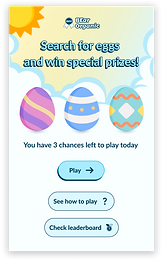
Game Page - Menu
Game Page - Game

Game Page - Leaderboard

Raffle Page - after

Final conclusion
Our idea started with the goals the client wanted to achieve and the need to grow our business. It was the first time we had created games in an app as a team, and it required a great deal of discipline, both creatively and organizationally.
There were two of us working in the UX team: me and my colleague, and given that UX design was very important for this campaign, we were working under a lot of pressure. We knew that this Easter Campaign could only be successful if it was understandable to the user. That is why we placed great emphasis on preparing onboarding so that the user would feel that the whole experience was quick and easy to go through.
We had to demonstrate strong negotiation skills on numerous occasions, both with the client and the creative agency. In addition, our timelines were strictly defined, and some technical issues only arose at later stages of the game's implementation. This forced us to make changes that were not always satisfactory from a UX designer's perspective. However, in the end, we always tried to find solutions that were easier from a technical point of view, but still tailored to user expectations.
Fortunately, thanks to the collaboration between the development teams and creative agencies, we were able to achieve very good results, which earned us the client's trust and led us to prepare three other campaigns with games over the following year.

It's your turn to play!
Find 7 eggs in the picture.
Did you manage to find them all?
If so, congratulations!